
by Ilse Gebhard, KAWO member
Ilse’s Gebhard’s essays are available in a digital book, Without a Net: Adventures with Butterflies and Moths, published by KAWO.
My first experience with raising black swallowtail (Papilio polyxenes) butterflies did not have a happy ending. I had found the caterpillar on parsley, one of its host plants, and, after I diligently fed it fresh parsley leaves for several days, it pupated. A couple of weeks later, much to my dismay, instead of a beautiful butterfly, a parasitic Ichneumon wasp emerged from the pupa. The larval stage of the wasp had completely eaten the developing butterfly inside the pupa.
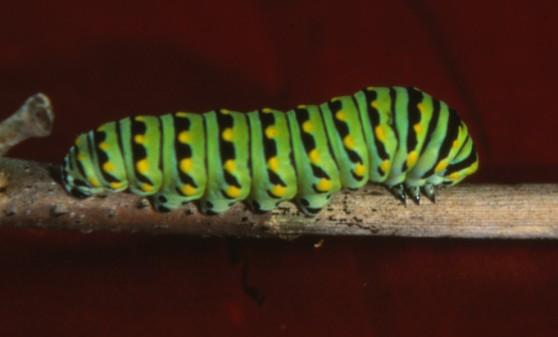
My next attempt had a happier outcome. I had picked some dill for our potato salad when I noticed some specks of dirt on it. Just as I was going to submerge the dill in water to wash it, something made me take a closer look at the specks. Wow! Those specks were three caterpillars. Both ends were black and had black hair but the middle was white and hairless. This fit the description of the early instars (larval stages) of the black swallowtail caterpillar, whose host plant can be dill, among many others in the parsley family.
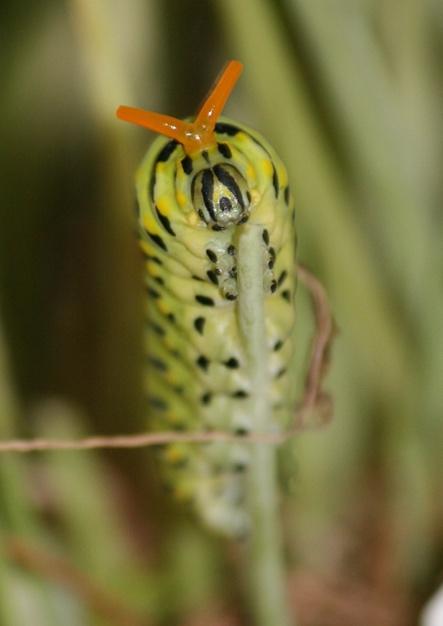
In due time, the caterpillars outgrew their skins and emerged smooth and green with black bands and yellow spots. Occasionally when I disturbed the caterpillars to dump out the frass (caterpillar poop) from the jars in which I was raising them, they would flash their orange osmeteria, emitting an amazingly strong odor for a critter just under two inches long. To my insensitive human nose, the odor was not unpleasant, but these chemical secretions serve well as a defense mechanism against insect predators like ants, spiders, and mantids.
Just before the caterpillars started to look for a place to pupate, they expelled a liquid along with the little barrels of frass. This is typical for all swallowtail species that I have raised.
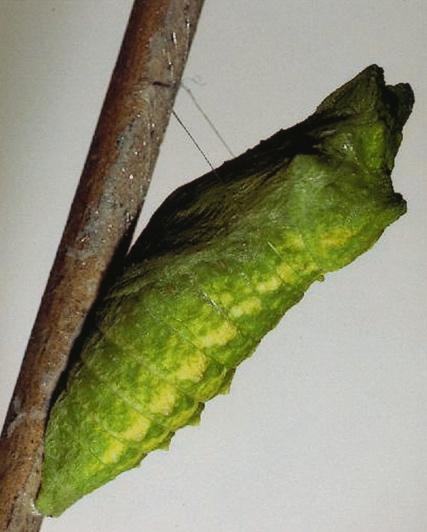
The first chrysalis to form was bright green; but much to my surprise, the other two were a mottled brown, similar to the twig they were attached to. I had wondered why one of my butterfly books showed it green and another one brown. What does the color difference mean? In the bird world the male is often brightly colored and the female is drab.
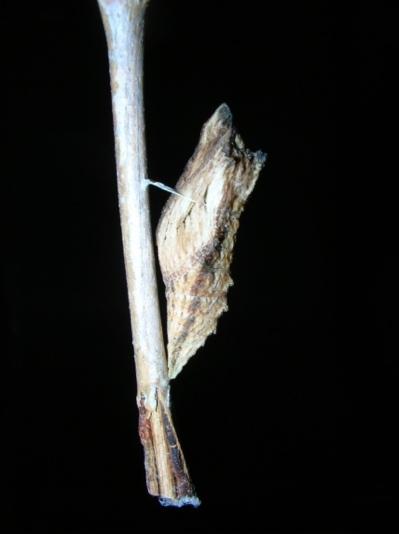
The chrysalis stage took fourteen days. From the green one a male emerged, while from the two brown ones, females emerged. I suppose the sample size is too small to draw the conclusion that a green chrysalis means a male butterfly and brown means female; but you can bet that I’ll be looking for more black swallowtail caterpillars to solve this mystery.
With plants in the parsley family like Queen Anne’s lace, sweet cicely, great angelica, golden alexanders, or rattlesnake master growing in the yard, I expect to find some, and I will even gladly share my dill should the other plants not suit their palate.