
by Ilse Gebhard, KAWO member
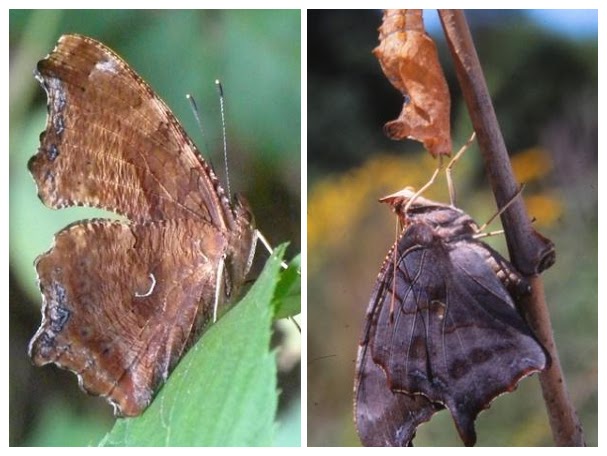
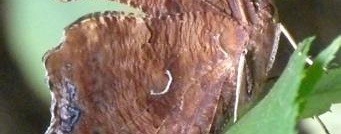
Two of Michigan’s common and closely related anglewing butterflies are the comma (also known as hop merchant) and the slightly larger question mark. They are called anglewings because of their ragged wing borders. Their similar orange color and black spot pattern makes them hard to distinguish, unless you are lucky and get to see their tiny silvery comma or question mark on the underside of the hindwing.
Both the comma and the question mark exhibit an unusual feature not found, to my knowledge, in other butterflies in our region. The black or “summer” form has significant black shading on the upper side of the hindwings, while the orange or “fall” form is mainly orangish-brown. The underside of both hind and forewings also shows these two forms, with the “summer” form heavily dark-shaded and the “winter” form less so. Both forms exhibit superb camouflage against tree bark when their wings are closed and the two forms correspond largely, but not completely, with the summer and fall broods.
But the similarity does not stop at appearance. Both species prefer woodlands and adjacent open areas. They rarely nectar on flowers but usually feed on tree sap, rotted fruit and decaying organic matter, and take moisture and nutrients from damp soils. They are both known to overwinter in Michigan by hibernating but the question mark also exhibits a pattern of migration further south in the fall and repopulating our area in spring. The increased cold hardiness of the comma is corroborated by its early flight date of March 22, a full month earlier than for the question mark.
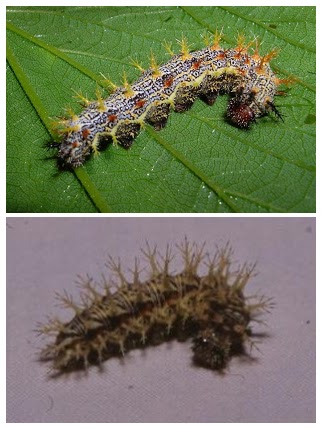
The caterpillar host plants for both the comma and the question mark are mainly elm, nettle, and hops, on which they lay their light green eggs. It was on nettle that a friend found caterpillars of both species in mid-July and gave me some to raise. While the caterpillars of both species are covered with branched spines, the color of the body and the spines differ.
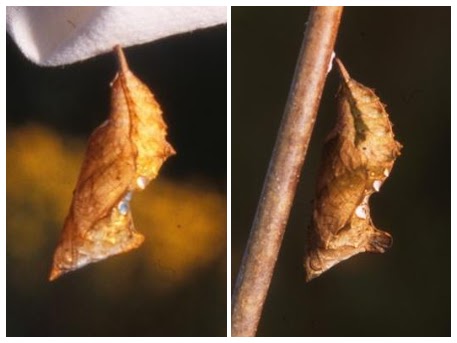
After feeding on nettle for about a week, the caterpillars of both species attached themselves to form their chrysalises. Chrysalis shape and coloration for both species were very similar and well suited for camouflage against a twig. The basic color was tan, mottled with yellow and orange hues. The shape was irregular with protuberances along one side. It had an axis of symmetry down the middle, and on either side of this axis was a row of silvery spots. This axis of symmetry is of course carried through to the butterflies that emerged seven to nine days later.
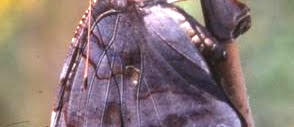
Can you find the tell-tale comma and question mark to distinguish the adults? (Hint: look above the white dot in the photo on the right.)
All photos by Russ Schipper